
 EN
EN
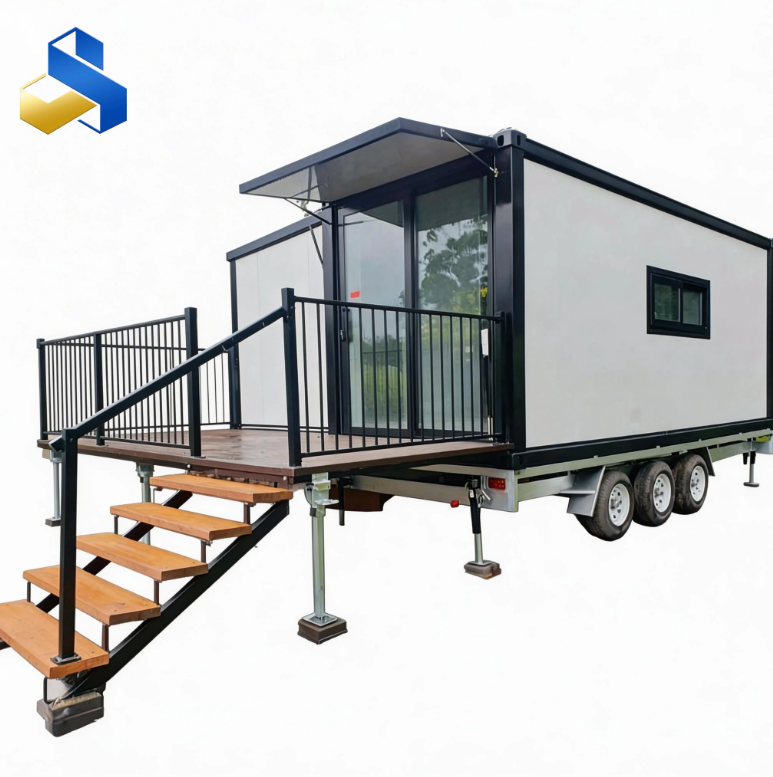
The Proposition: A Home That Moves
Most housing is anchored to a fixed foundation. Once built, it stays put. Trailer integrated houses reject that assumption entirely. They're built on reinforced trailer chassis with highway-rated axles, suspension, and braking systems, designed to be towed from site to site without sacrificing the comforts of a permanent dwelling. The proposition is simple: a fully functional home that can relocate when the occupant does. That capability changes the calculus for anyone whose work or lifestyle involves frequent moves—and it's opening up use cases that stationary housing simply cannot serve.
What Makes It "Integrated" Rather Than Just a Trailer
The distinction matters. A standard travel trailer is built for occasional use, with lightweight materials, minimal insulation, and appliances sized for weekend trips. A trailer integrated house is built for full-time occupation. The structure uses residential-grade materials throughout—steel framing, proper insulation, full-size appliances, and the same fixtures found in stationary homes. The integration refers to the systems: electrical, plumbing, HVAC, and sometimes solar and battery storage are all designed as a unified whole, not as add-ons bolted onto an RV chassis. The result is a unit that feels like a home when parked, not like a camper that's been stretched beyond its intended use.
The Economic Logic of Mobile Living
The cost comparison between a trailer integrated house and a traditional home reveals some surprising dynamics. A traditional U.S. home runs $100–$200 per square foot for the structure, with land costs adding another $50,000 to $200,000 or more depending on location. A trailer integrated house eliminates the land cost in the traditional sense—it doesn't require a permanent foundation, just a level spot to park and connect. The upfront investment is substantially lower, and the ongoing cost structure can be adjusted by choosing off-grid configurations that reduce or eliminate utility bills. According to LP Information, the global mobile container house market—which includes trailer-integrated designs—is projected to grow from USD 1.59 billion in 2025 to USD 2.49 billion by 2031. That growth isn't coming from people buying second homes; it's coming from businesses and individuals who need housing that moves with their work or lifestyle.
A Project Chasing the Sun
In early 2024, a renewable energy contractor working on a solar farm installation in Nevada's high desert faced a familiar industry problem. The project site was sixty miles from the nearest town, and the crew of eighteen needed sleeping quarters that wouldn't require an hour-long commute each way. The contractor had used travel trailers on previous projects, but those units were cramped, poorly insulated, and not built for the extended use they were getting. The solution was five trailer integrated houses, each configured to sleep four workers in bunk-style arrangements with a shared kitchenette and bathroom. Each unit was fully self-contained, with onboard water tanks, a diesel heater for cold desert nights, and a 5 kW solar array with battery storage that reduced reliance on the site's temporary generator. The units were towed to site by pickup trucks, leveled on gravel pads, and connected to a temporary power distribution system within a single day. Over the six-month project, the crew had consistent housing that moved with them when the project shifted to a new site forty miles east. The contractor's cost analysis showed savings of over $120,000 in hotel and per-diem expenses compared to the alternative of housing the crew in town.
Self-Sufficiency as a Standard Feature
Modern trailer integrated houses are being designed with off-grid capability as a baseline rather than an option. Solar panels on the roof, lithium battery banks, inverters, and water recovery systems are becoming standard equipment rather than costly add-ons. Some designs now incorporate up to 100 kWh of battery storage—enough to run residential appliances, lighting, and climate control for extended periods without shore power. Water tanks ranging from 200 to 500 gallons provide days or weeks of supply depending on usage, and some units include on-board water treatment and filtration. This isn't just about environmental consciousness; it's about operational independence. For remote work sites, disaster response operations, or off-grid homesteaders, a trailer integrated house offers a level of autonomy that traditional housing simply cannot provide.
What Gets Compromised in a Mobile Design
Every design choice involves trade-offs, and mobility imposes some hard constraints. Weight is a constant consideration—every pound added for comfort or durability reduces fuel economy and may require a heavier towing vehicle. Interior space, while generous for a mobile unit, remains smaller than a stationary home. The typical 200 to 400 square feet works well for singles or couples but gets tight for families. And while trailer integrated houses are built to highway standards, they're not immune to the wear of frequent travel. Suspension components wear out, seals degrade, and folding or slide-out mechanisms require regular inspection and maintenance. These aren't reasons to avoid the format, but they're real operating costs that buyers need to account for.
The Standards That Make Them Roadworthy and Habitable
Trailer integrated houses built for export or commercial use must comply with multiple layers of standards. The chassis and towing systems must meet Department of Transportation regulations for roadworthiness—braking performance, lighting, and weight distribution all have to be certified. The living quarters, even when built on a trailer chassis, are often constructed to ISO container standards for structural integrity, ensuring they can survive both the road and the demands of daily living. In the European market, CE certification has become a baseline requirement for units intended for habitation, covering electrical safety, fire resistance, and structural performance. These aren't bureaucratic hurdles; they're evidence that the unit has been engineered to a standard that goes beyond what the travel trailer industry typically provides.
Comparing Mobile Living Options
Feature |
Trailer Integrated House |
Travel Trailer (RV) |
Stationary Container Home |
Construction quality |
Residential-grade |
Lightweight/occasional |
Industrial-grade |
Insulation |
Full, year-round |
Minimal |
Good (with upgrades) |
Off-grid capability |
Extensive (built-in) |
Limited |
Good (with add-ons) |
Towing weight |
7,000–12,000 lbs |
3,000–8,000 lbs |
Not towable |
Intended use |
Full-time occupation |
Weekend/camping |
Permanent placement |
Typical cost |
$50,000–$100,000 |
$25,000–$80,000 |
$30,000–$60,000 (finished) |
Where Mobile Living Makes the Most Sense
Trailer integrated houses are not for everyone, and they don't pretend to be. They excel in specific scenarios: remote construction and energy projects where workers follow the job; disaster response where speed of deployment matters more than permanence; seasonal agriculture or forestry work where the workforce migrates with the seasons; and transitional living for people who need a functional home while figuring out a more permanent arrangement. The common factor is mobility—the ability to pick up and move without abandoning a significant capital investment. For these users, a trailer integrated house is not a compromise; it's the most practical tool for the job.
Manufacturers like Gouyu, with established capabilities in integrated systems design and a track record of international certification including CE compliance, are well-positioned to serve these mobile living markets. Their units have been shipped to European and Middle Eastern destinations, demonstrating that trailer integrated houses can meet the standards required for export while delivering the features that mobile workers and remote-site operators actually need.
Table of Contents
- The Proposition: A Home That Moves
- What Makes It "Integrated" Rather Than Just a Trailer
- The Economic Logic of Mobile Living
- A Project Chasing the Sun
- Self-Sufficiency as a Standard Feature
- What Gets Compromised in a Mobile Design
- The Standards That Make Them Roadworthy and Habitable
- Comparing Mobile Living Options
- Where Mobile Living Makes the Most Sense